
How to Transform Your Organization With a Company Brain
A practical 30-, 60-, and 90-day plan for changing how teams find context, delegate recurring work, and keep people accountable.
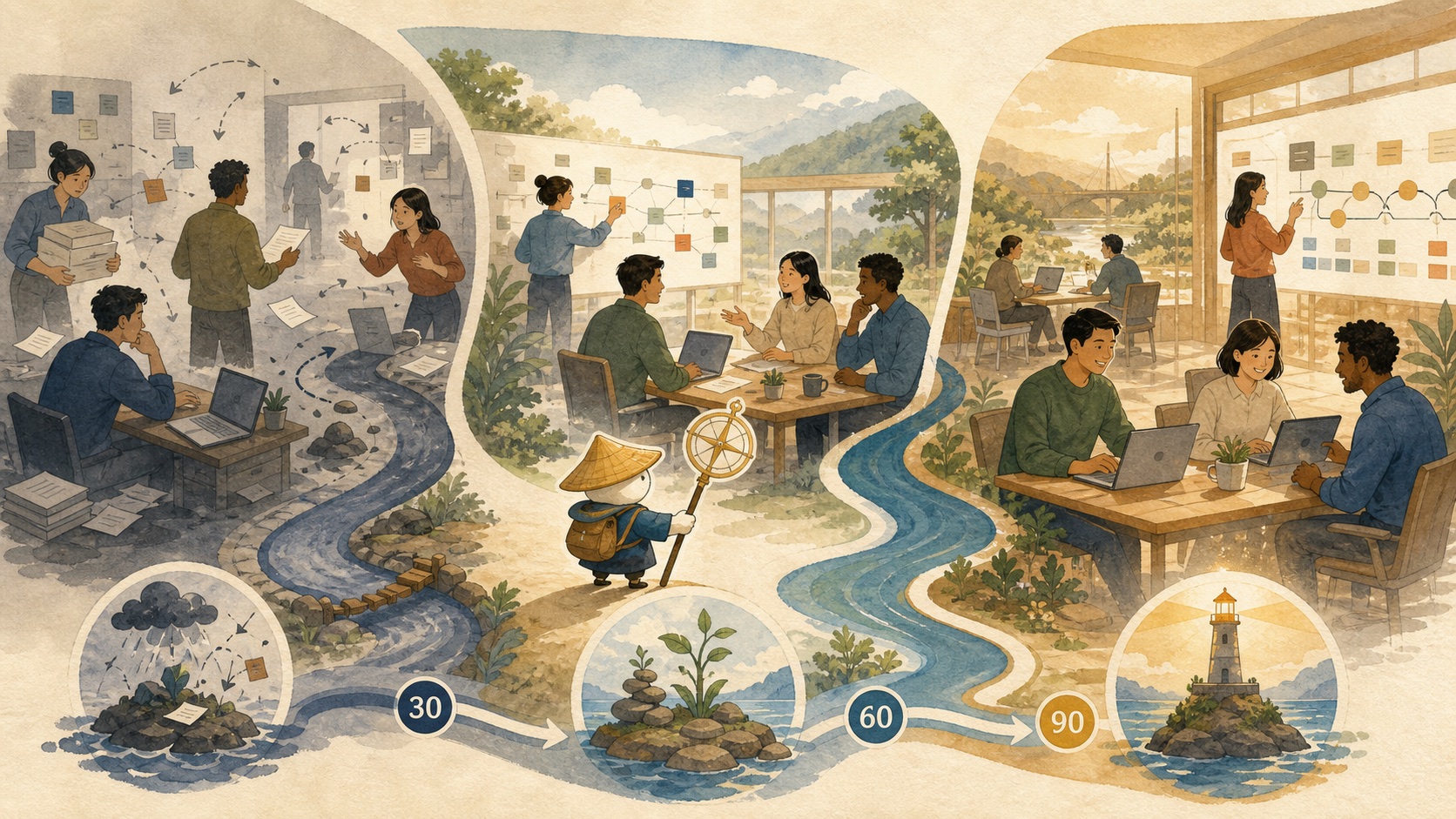
A company brain changes an organization when it moves recurring work from “find, interpret, and chase” to “delegate, review, and improve.” The operating-model change is not that AI makes every decision. It is that teams can access shared context and hand bounded work to agents while people retain accountability for judgment, exceptions, and commitments.
The operating-model change is from searching to delegating
In a search-led organization, a person assembles context each time work starts. They look through messages, documents, systems, and institutional memory, then decide what to do. In a delegation-led organization, the person states the outcome and the system assembles a traceable draft, plan, or next step from approved context.
This does not remove expertise. It moves expertise toward setting the standard, reviewing exceptions, improving the workflow, and deciding when the evidence is insufficient. A manager’s job becomes less about relaying status and more about improving the decisions that the team repeats.
Change recurring knowledge work before attempting broad automation
Start with work that is repeated, sourceable, and reviewable. Weekly business reviews, account preparation, issue triage, meeting follow-through, and launch updates are stronger starting points than pricing exceptions, performance decisions, or sensitive HR actions.
| Before shared context | With a company brain | Human remains accountable for |
|---|---|---|
| An operator assembles a weekly update from several tools. | An agent prepares a cited update and flags missing inputs. | Priorities, interpretation, and final commitments. |
| A rep asks several people for account history. | An agent creates a brief from connected, permitted sources. | Customer strategy and external communication. |
| A manager chases action items after meetings. | A system proposes owners and due dates in the original thread. | Acceptance, trade-offs, and follow-through. |
Managers, operators, and specialists use agents differently
Managers need a faithful view of change: what moved, what is blocked, who owns the next decision, and what needs escalation. Operators need consistent preparation and reliable handoffs. Specialists need fast access to the evidence behind a question without surrendering their professional judgment.
Design role-specific outputs instead of one generic company chatbot. A support lead needs an incident timeline. A product manager needs the decisions and customer signals around a roadmap question. A finance operator needs a reconciled exception list. Shared context should improve each role’s next decision, not merely make everyone read the same summary.
Use a 30-, 60-, and 90-day rollout
| Period | Focus | Evidence of progress |
|---|---|---|
| Days 1-30 | Map one workflow, source owners, permission boundaries, and review criteria. | A team can trace a manual result to its sources and agree on what a good output looks like. |
| Days 31-60 | Run the workflow with a human reviewer and collect corrections. | Outputs are cited, exceptions are visible, and corrections are categorized. |
| Days 61-90 | Add a bounded action and a recurring review of outcomes. | The workflow saves time or improves completion without adding hidden risk. |
Every phase should have a named owner. Buying an AI product does not transform an organization on its own. The change happens when someone owns the source quality, workflow design, adoption, and evaluation.
Treat context quality and permissions as adoption work
People will not rely on a system that confidently repeats old decisions, exposes the wrong information, or loses the source behind a claim. Establish a simple rule: every high-stakes output must show its evidence, uncertain claims must be labeled, and access should not exceed the source permissions.
Make correction easy in the same place work happens. “That account owner changed,” “this policy was replaced,” and “do not use this source for support replies” are valuable feedback. Capture those corrections as workflow improvements, not as private frustration.
Keep approval where accountability belongs
Automation should not silently make a customer promise, approve a discount, evaluate a candidate, change payroll data, or take a legal position. An agent can collect evidence, draft alternatives, and route a decision to the accountable person. The person should be able to inspect the sources and choose an outcome.
Human review is not a temporary failure mode. For ambiguous, irreversible, or high-impact work, it is part of the design. The goal is to reduce the preparation burden so the person spends attention where it matters.
Measure work quality, not AI activity
Track cycle time, completion rate, rework, escalation quality, source fidelity, and exception rate. Also track adoption in the workflow itself: how often people accept a prepared brief, correct it, or bypass it. A large number of prompts is not proof of transformation.
Use the first 90 days to decide whether the system earned another workflow. The right next use case is the one where the current process repeatedly loses context, not the one with the most impressive demo.
Create an exception taxonomy before scaling
Do not file every correction under “the AI was wrong.” Classify failures by stage: missing source, stale source, identity mismatch, ambiguous policy, permission denial, weak plan, tool failure, or reviewer disagreement. The category tells you whether to improve source ownership, retrieval, workflow design, access controls, or the task contract.
Track both frequency and consequence. A small number of high-impact approval mistakes deserves more attention than many harmless formatting corrections. This creates a practical escalation policy: auto-complete low-risk work only after a stable run history, keep medium-risk work reviewable, and route high-impact or ambiguous work to a named decision-maker. That is how autonomy grows without becoming a leap of faith.
Continue the work
Sources used in this guide
Anthropic’s guidance on matching agent systems to well-defined work; Slack’s app-permission guidance.
Frequently asked questions
How long does AI-driven organizational transformation take?
A focused workflow can show evidence in 30 to 90 days, but changing operating habits takes longer. Use the first 90 days to establish governance, prove one workflow, and create a repeatable review cadence.
What should an organization transform first?
Start with recurring, cross-tool work that has clear inputs, an accountable owner, frequent handoffs, and a measurable result, such as a weekly operating review or renewal brief.