What Is an Agent Harness for Knowledge Work?
Understand the runtime around an AI model: context, tools, permissions, state, approvals, observability, error recovery, and evaluation.
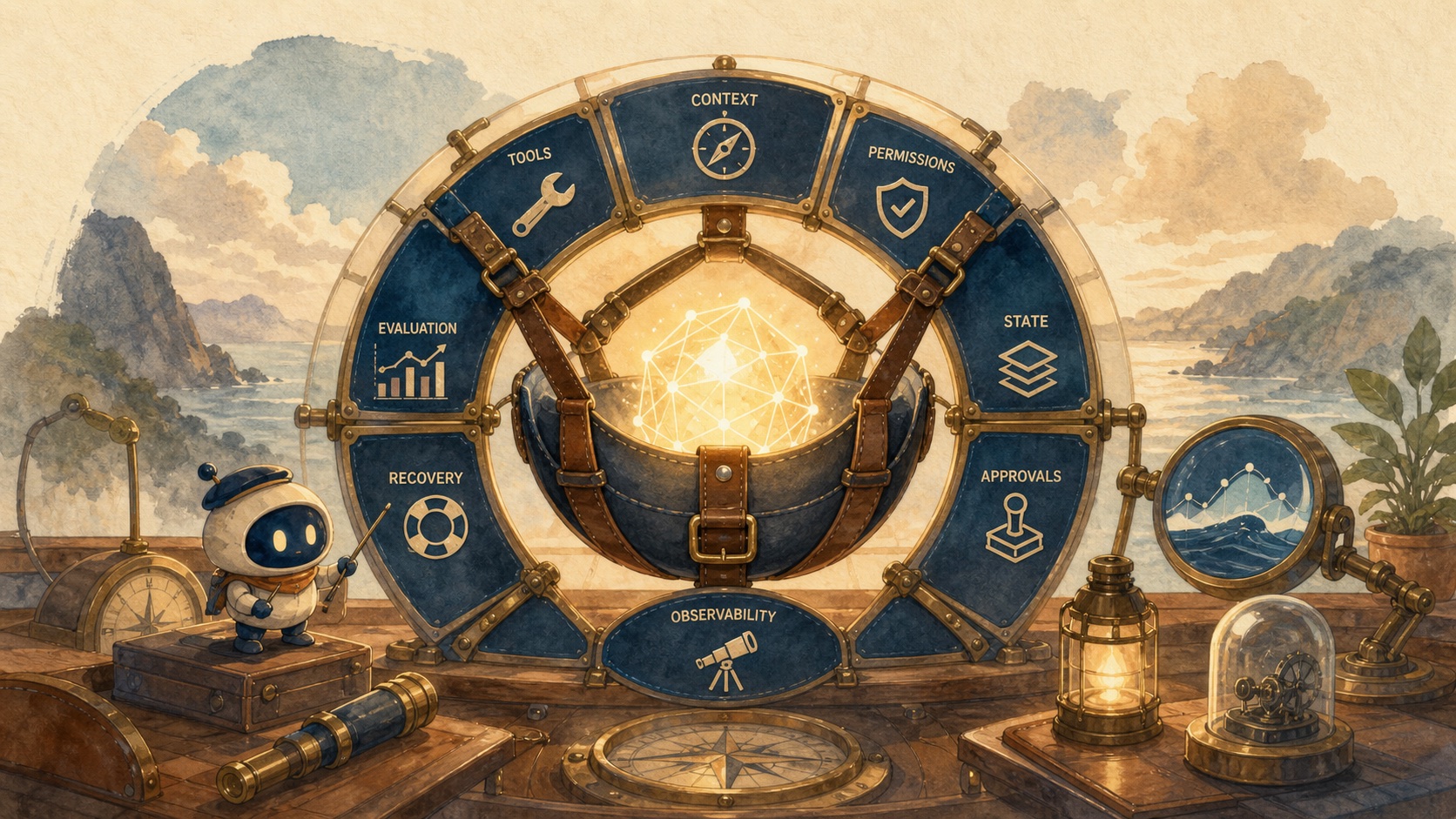
An agent harness is the runtime around an AI model that gives it the context, tools, state, permissions, approvals, observability, and error recovery required to complete work. The model generates and reasons; the harness determines what information it receives, what it can do, how it is checked, and what happens when a task goes wrong.
Separate the model, agent, framework, and harness
| Term | What it provides | What it does not guarantee |
|---|---|---|
| Model | Language, reasoning, and generation capability. | Access to company context or safe tool use. |
| Agent | A model pursuing a goal through one or more steps. | A dependable operating environment. |
| Agent framework | Code primitives for tools, orchestration, and state. | A complete policy, security, or evaluation model. |
| Agent harness | The runtime contract around context, tools, controls, and feedback. | Good outcomes without careful workflow design. |
A prompt tells a model what to attempt in one interaction. A harness governs how the system works across interactions, tools, time, and people. For knowledge work, that difference matters more than a clever prompt because the work lives in changing systems and has real consequences.
Build the harness from eight operating parts
- Task contract: trigger, goal, output, and stopping condition.
- Context retrieval: relevant, permission-aware evidence with provenance.
- Tools and execution environment: limited capabilities, safe credentials, and sandboxes where appropriate.
- State and memory: durable task state, checkpoints, and reusable preferences with clear boundaries.
- Planning: a way to decompose work and expose material choices.
- Approvals: people at the points where judgment or accountability belongs.
- Observability: inputs, sources, tool calls, outputs, failures, and audit history.
- Evaluation and feedback: tests, outcomes, corrections, and a path to improve the workflow.
Give agents a bounded task, not an abstract department
“Manage customer success” is not a task an agent can safely own. “Every Monday, prepare a cited health brief for accounts with declining activity, then ask the account owner to review the draft” is a bounded task. It names the trigger, inputs, output, reviewer, and action boundary.
Boundaries make long-running work possible. The harness can checkpoint progress, resume after a tool failure, ask a person when a required input is absent, and stop when the defined output is ready. Without that structure, an agent either does too little or takes uncontrolled initiative.
Make permissions and tools part of the product
Tool access is not an implementation detail. It determines an agent’s real authority. A reliable harness uses least privilege, separates read from write access, scopes credentials to the workflow, and keeps the human approval rule close to the proposed action.
For technical work, an execution environment may need a sandbox, network rules, and a way to inspect changes before they are applied. For business work, the equivalent controls are source permissions, destination restrictions, approval steps, and a traceable record of the change.
Design for recovery and evaluation
Failures are expected: a source is unavailable, identity resolution is ambiguous, a tool times out, or the model sees conflicting evidence. A strong harness records the failure, retries only when safe, preserves a checkpoint, and escalates with enough context for a person to decide.
Evaluate the full workflow, not a model response in isolation. Test source fidelity, permission behavior, tool correctness, completion, exception handling, cost, and the quality of human review. A new model can improve one part of the system, but a weak harness will keep producing weak operational outcomes.
Why the harness can matter more than changing models
Models change quickly. The durable advantage in knowledge work is the system that knows which sources are current, what a person is allowed to see, how to use a tool safely, and when to ask for help. That is why a company brain and an agent harness are complementary: one provides organizational context; the other makes that context usable in a controlled runtime.
Luffy’s Slack-first approach is one example of the interaction decision inside a harness: keep requests, evidence, and review close to the team’s existing conversations. The right harness for another company may use a different interface, but it still needs the same operating parts.
Treat each workflow as a state machine
Long-running knowledge work should have explicit states: queued, retrieving, awaiting input, draft ready, awaiting approval, executing, verified, and failed. A state model makes it clear what can resume after an interruption, what requires a person, and which tools are allowed at a given moment.
Pair this with idempotency keys and compensation rules. Retrying a research step is normally safe; retrying a send action may not be. If an agent creates a task but fails before posting the Slack summary, it should detect the existing task on resume rather than create another. If a downstream write cannot be reversed, the workflow needs a stronger approval gate before execution. These controls are where trustworthy autonomy is actually built.
Continue the work
Sources used in this guide
Anthropic’s practical overview of agent systems; OpenAI documentation on building agents.
Frequently asked questions
What is an agent harness?
An agent harness is the runtime around an AI model that manages context, tools, permissions, state, approvals, observability, retries, recovery, and evaluation for a defined job.
Why does an AI agent need a harness?
Models do not inherently know company permissions, durable workflow state, tool limits, or what proves a business outcome. The harness supplies those operational constraints and feedback loops.